OK people, this one I found some months ago on a portuguese web-site. I used Google translator so indulge me if the translation is not perfect.
Ten absurd deaths
1. To embrace the reflection of the moon
The Chinese poet Li Po is considered one of the two major figures of the history of Chinese literary. He was well known for being a heavy drinker and it is also known that he wrote many of his greatest poems while drunk. And drunk he was was the night he fell from his boat and drowned in the river Yangt-ze simply because he was trying to embrace the moon's reflection in the water.
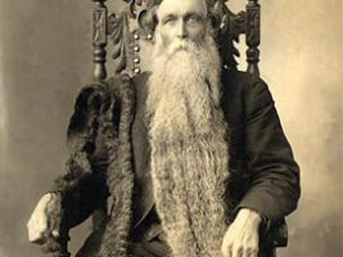
 2. Though the beard
Austrian Hans Steininger was famous for having the longest beard in the world (nearly five feet) and because he die because of it. One day in 1567 there was a fire in his city and on the trail Hans forgot to wrap his beard, stepped on it, lost his balance, tripped and broke his neck.
 3. By holding the pee
The noble and the Danish astronomer Tycho Brahe was an interesting and eccentric character. He had a trained moose as a pet and also lost the tip of his nose in a duel with another Danish nobleman and had to use a false nose made of silver and gold, but that's another story. It is said that Tycho had to hold off the urge to go to the bathroom during a banquet particularly extensive in 1601 (getting up in the middle of a dinner was considered as something really offensive), so much so that your bladder, taken to the limit, developed an infection for which he died. Further analysis suggested that Tycho died in reality by mercury poisoning, but this conclusion is not as interesting as the original story...
 4. Through the baton of the orchestra
While conducting a symphony for the French King Louis XIV in 1687, Jean Baptiste Lully was so focused on keeping the rhythm by striking a stick against the floor (this was the usual method before they started using the baton), that he crushed the thumb foot but refused to stop. The wound turned into a gangrene, but the stubborn Lully refused to amputate it. The gangrene spread and the conductor died. Ironically, the hymn that he was driving was in celebration of the restoration of Louis XIV from an illness.
 5. For dessert
Adolph Frederic King of Sweden loved to eat and died because of it. Known as "The king that has eaten to death," died in 1771 aged 61 because of a digestive problem after eating, literally, "more than the belly." The dinner was composed of greedy lobster, caviar, sauerkraut, cabbage soup, smoked deer, champagne and fourteen milk puddings stuffed with almonds, his favorite treat.
 6. By demonstrating to the jury
After the U.S. civil war, a controversial politician Clement Vallandigham of Ohio, became a successful lawyer who rarely lost a case. In 1871 he defended Thomas McGehan, accused of shooting a guy named Tom Myers during a quarrel in a bar. Vallandigham's defense was based on that Myers had shot against himself while wielding his pistol when he was kneeling. To convince the jury, Vallandigham decided to demonstrate his theory. Unfortunately, he used by mistake a loaded pistol and ended up shooting him even proving the theory of accidental shooting and getting exonerate his client.
 7. By biting his tongue
Allan Pinkerton, famous for creating the detective agency that bore his name, died of an infection after biting his tongue slipped when on the street.
 8. Though the thumb
One 1911 morning, the famous whiskey distiller Jack Daniel decided to go to work earlier. He wanted to open his safe but could not remember the combination. Enraged, Daniel punched the safe and broke the big toe that became infected causing his death.
 9. Because of an orange peel
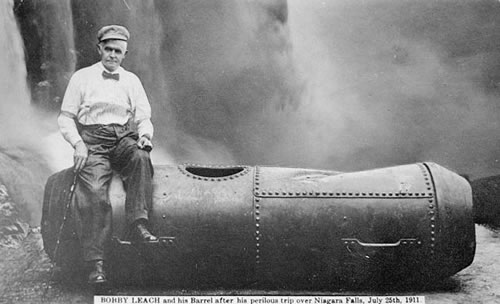
Bobby Leach was not afraid to challenge the death and in 1911 he was the second person in the world to survive a fall in a barrel at Niagara Falls. He accomplished many feats of this kind, and that's why his death is especially ironic. Walking along a street of New Zealand, Leach slipped on a piece of orange peel. He broke his leg that had to be amputated. He died due to complications from surgery.
 10. For failure of the parachute
In 1911, the French tailor Franz Reichelt decided to test his invention, a combination of above with a parachute, jumping from the Eiffel Tower. He told the authorities that he would use a dummy, but in the last minute he decided to prove it himself. His invention did not work.









 ) of Nature?


