The Beatles 'Rubber Soul' turns 50...US vs UK

Discussions of other bands, including D21C/ROTS should go here.

Moderators: The Freedom Man, TheDoorsMusic

Post Reply
User avatar
jamestkirk
Senior Member
Posts: 5816
Joined: Tue Mar 20, 2007 9:11 pm
Location: The Music Of My Mind

The Beatles 'Rubber Soul' turns 50...US vs UK

Post by jamestkirk »

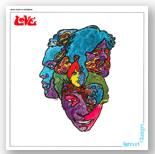
Wow, 50!....still have my 1965 first pressing MONO vinyl and it is still as fresh as the day I removed the shrink wrap! What a happy day when I first saw Rubber Soul in the record shop window - Dec. 6, 1965...what a cool album cover. A fifteen year-old drummer's musical dream (Ringo was the man at that time to my young eyes and ears-the Fabs made a garage band's aspirations actually seem possible). That beautiful record jacket cover was so sophisticated and we knew something amazing was contained within.

It is very interesting to get the background story of how the US track listing came about.--jtk


The Beatles’ ‘Rubber Soul’ Turns 50

Is it possible to make a better Beatles?
Debating different versions of an iconic album


By MARC MYERS / Wall Street Jounal


Image


The 12-song album issued in the U.S. was markedly different from the British version, which featured 14 songs. PHOTO: COURTESY OF UNIVERSAL MUSIC GROUP


For most American teens, the arrival of the Beatles’ “Rubber Soul” 50 years ago was unsettling. Instead of cheerleading for love, the album’s songs held cryptic messages about thinking for yourself, the hypnotic power of women, something called “getting high” and bedding down with the opposite sex. Clearly, growing up wasn’t going to be easy.

Released in the U.K. on Dec. 3, 1965, and in the U.S. three days later, “Rubber Soul” remains one of the most critically acclaimed albums in rock history, influencing a generation of artists, including Brian Wilson, Bob Dylan and Stevie Wonder. It also marked rock’s shift from formulaic pop to studio experimentation and high art.

But while “Rubber Soul” has been hailed as an epic masterpiece and one of the first fully developed folk-rock albums, the vision for the U.S. release wasn’t entirely the work of John, Paul, George and Ringo or the Beatles’ producer, George Martin.
The 12-song album issued in the U.S. was markedly different from the British version, which featured 14 songs. Though both versions shared Robert Freeman’s cover photo and psychedelic lettering (ginger here and burnt orange in the U.K.), the U.S. version dropped two songs and replaced two others.

Over the years, many U.S. critics have hailed the British release as the true masterpiece, a pure reflection of what the Beatles and Mr. Martin intended. But the U.S. version of “Rubber Soul,” with its more consistently poetic sound and narrative, is arguably the more powerful statement. It’s also the version that changed the direction of American rock.

The invisible hand behind the U.S. release belonged to Dave Dexter Jr., the head of Capitol’s international A&R in Los Angeles. Dexter and his team set out to keep the compelling folk narrative running throughout the album.

In 1965, Capitol had contractual permission to alter British versions of Beatles albums for the U.S. market. The agreement dated back to 1955, when British EMI purchased Capitol. At the time, EMI didn’t want to lose U.S. executives and figured they’d know best how to milk their own market.

Once the Beatles were signed to Capitol in late 1963, Dexter was put in charge of reprogramming U.K. versions of their albums for the U.S. market. U.S. versions usually used 11 songs to stay within licensing budgets. The dropped songs were then used on subsequent albums released only in the U.S.

But by late 1965 the Beatles had a problem. Bob Dylan’s album “Highway 61 Revisited” and the single “Like a Rolling Stone,” with its socially conscious folk-rock theme, was resonating with draft-age listeners in the States. To remain relevant, the Beatles needed a more mature, acoustic album.

Fresh off their successful stadium tour in August ’65, the Beatles returned to London and recorded “Rubber Soul” in just four weeks. When the recording was completed, a master reel was shipped to Dexter in Hollywood.

Earlier that fall, Brian Epstein, the Beatles’ manager, spoke with Voyle Gilmore, Capitol’s head of U.S. A&R. Gilmore, in turn, wrote a memo to Capitol president Alan Livingston and Dexter urging that the cover and tracks for the American “Rubber Soul” be identical to the British version.

Dexter pushed back, explaining that a 14-song album was out of the question due to costs and that the covers should be different. Capitol compromised by featuring 12 songs instead of the customary 11 but retained the same covers.

Then Dexter went to work on the U.S. track list. Instead of just dropping two songs, he replaced the raucous “Drive My Car” and cornball “What Goes On,” which opened sides 1 and 2, respectively, on the U.K. version.

In those critical lead-in slots, he inserted “I’ve Just Seen a Face” and “It’s Only Love”—acoustic songs he had cut from the British version of “Help!” for it’s U.S. release. Next, he dropped the alienating “Nowhere Man” and mystical “If I Needed Someone” from “Rubber Soul.”

All of the changes were brilliant and resulted in a more cohesive album. But when the U.S. version was released, the Beatles voiced displeasure to EMI, which demanded that Dexter no longer work on Beatles releases. In early 1966, Dexter was replaced by Bill Miller, who programmed the next two U.S. releases—“Yesterday and Today” and “Revolver.”

Today, most Beatles fans view Dexter, who died in 1990, as a villainous rock-hating executive who resented the Beatles and whose programming approach diluted the band’s U.S. releases.

Whatever Dexter’s shortcomings, the Beatles albums he programmed for Capitol are the ones American teens heard and loved. As for “Rubber Soul,” it may have been his greatest achievement, turning an unfocused album into a taut acoustic story of self-awareness and romantic confusion. It also provided millions in the U.S. with their first gentle glimpse of adulthood.

Mr. Myers, a frequent contributor to the Journal, writes daily about music and the arts at JazzWax.com.
Last edited by jamestkirk on Thu Dec 03, 2015 5:03 pm, edited 15 times in total.
"After silence, that which comes nearest to expressing the inexpressible is music".

-Aldous Huxley
User avatar
jamestkirk
Senior Member
Posts: 5816
Joined: Tue Mar 20, 2007 9:11 pm
Location: The Music Of My Mind

Post by jamestkirk »

The Beatles' 'Rubber Soul' turns 50

Jayme Deerwester, USA TODAY 11:08 a.m. EST December 3, 2015

Last week marked the 50th birthday of Arlo Guthrie's Thanksgiving classic Alice's Restaurant and today marks a half-century for the Beatles' sixth album Rubber Soul. (The title was a play on the term "plastic soul," used by black musicians to describe Mick Jagger's sound.)

Going down the track listing, you'll note that most Beatles compilations pull liberally from Rubber Soul — it produced the classics Michelle, Norwegian Wood, Girl, Drive My Car and the wistful In My Life. It also marked the Beatles' shift from boy band to serious artists.

"Rubber Soul is this great transition to a more sophisticated Beatles," says anthology producer Martin Lewis, who claims it as his personal favorite. He told USA TODAY, "There's warmth, emotion and a level of maturity beyond their years in songs like In My Life. Rubber Soul is their last quintessential English album. It's very Edwardian."

So to paraphrase John Lennon's opening line to Girl, go ahead and listen to their story.
"After silence, that which comes nearest to expressing the inexpressible is music".

-Aldous Huxley
User avatar
jamestkirk
Senior Member
Posts: 5816
Joined: Tue Mar 20, 2007 9:11 pm
Location: The Music Of My Mind

Post by jamestkirk »

As far as the differences between the US release and the UK release, I know it is whatever version we grew up with but for me the two tracks included that were from the UK's HELP and the exclusion of a couple of the UK tracks (because they appeared on the Butcher LP)...was accidentally a GENIUS move by Capital Records!! It is a complete and perfect album, start to finish.

US release

Side One
1. "I've Just Seen a Face"
2. "Norwegian Wood (This Bird Has Flown)"
3. "You Won't See Me"
4. "Think for Yourself"
5. "The Word"
6. "Michelle"

Side two

1. "It's Only Love"
2. "Girl"
3. "I'm Looking Through You"
4. "In My Life"
5. "Wait"
6. "Run for Your Life"

....................

UK release

Side 1
1. Rubber Soul Documentary
2. Norwegian Wood (This Bird Has Flown) (2009 - Remaster)
3. You Won't See Me (2009 - Remaster)
4. Nowhere Man (2009 - Remaster)
5. Think For Yourself (2009 - Remaster)
6. The Word (2009 - Remaster)
7. Michelle (2009 - Remaster)

Side 2
8. What Goes On (2009 - Remaster)
9. Girl (2009 - Remaster)
10. I'm Looking Through You (2009 - Remaster)
11. In My Life (2009 - Remaster)
12. Wait (2009 - Remaster)
13. If I Needed Someone (2009 - Remaster)
14. Run For Your Life (2009 - Remaster)


UltimateClassics.com

By the time the Beatles reached America, their record company, Parlophone/EMI, had already released two albums and a handful of singles in their native England. EMI’s U.S. label, Capitol, had repeatedly rejected the group’s output for a year, but as word began to spread in America at the end of 1963, it finally relented and got behind the group’s latest single, ‘I Want to Hold Your Hand.’

This put Capitol in the enviable position of having a considerable backlog of songs at the very moment U.S. fans couldn’t get enough of the Beatles. But instead of putting out the same albums as Parlophone, Capitol compiled new ones out of whatever it wanted, with no concern for the Beatles’ artistic choices. There were a few reasons for this: For starters, U.S. albums rarely included more than 12 songs (possibly out of fear of fidelity loss due to “groove-cramming”), and all of the U.K. albums contained 14 tracks. Then there was the matter of the non-LP singles, a practice common in the U.K. but not in the U.S. Capitol needed a place to put hits like ‘I Want to Hold Your Hand’ and ‘She Loves You.’ In those first few years, the Beatles operated under a breakneck schedule of a new single every three months and a new LP every six months.

Complicating matters even more was the issue of ‘Introducing . . . the Beatles,’ a near-repackaging of their U.K. debut, ‘Please Please Me,’ which was licensed to Vee-Jay Records when Capitol passed on it in the summer of 1963. As part of a lawsuit settlement, the rights to those songs were transferred to Capitol in October 1964 – a year and a half after they were released overseas.

For their part, the Beatles were unhappy with this practice, but in all fairness, Capitol never had the chance to catch up. The band was simply too prolific in the early days. But by the time of 1967’s ‘Sgt. Pepper’s Lonely Hearts Club Band,’ the group was able to demand that the same album be released worldwide (with a couple of exceptions).

When the Beatles first issued their entire catalog on CD in 1987, they decided to streamline their records once and for all, and only the original U.K. albums were released (except for ‘Magical Mystery Tour'; see below for explanation). While this may have confused American fans who couldn’t get ‘Beatles VI’ or bought ‘Rubber Soul’ expecting to hear it begin with ‘I’ve Just Seen a Face’ only to get ‘Drive My Car’ instead, it ended their messy catalog headache for good.

Until 2004 that is, when Capitol put out a box of the group’s first four U.S. records, replicating track listings and artwork, and followed it up two years later with the next four albums. And now there’s ‘The U.S. Albums,’ which compiles Capitol’s 12 LPs (including the first CD appearance of ‘The Beatles Story,’ a two-record cash-grab from 1964 made up of interviews and press conferences) and the soundtrack to ‘A Hard Day’s Night,’ which originally came out on United Artists. We’ve compiled this guide to the Beatles’ U.S. albums, showing how their label assembled them from what was available.
"After silence, that which comes nearest to expressing the inexpressible is music".

-Aldous Huxley
Post Reply